
Moderation in Meta
A rejected ad costs you launch days; repeated rejections put the whole ad account at risk — here’s how review works and how to pass it the first time
Every ad you launch goes through Meta’s review before it spends a cent — and for an agency the stakes are bigger than one delayed campaign. Rejections accumulate against the ad account, and the ad account is the agency’s livelihood: lose it, and every client on it goes dark at once. The good news: the review is predictable. Lead-gen ads get rejected for the same handful of reasons, and all of them are avoidable at the copy-and-creative stage.
How the review works
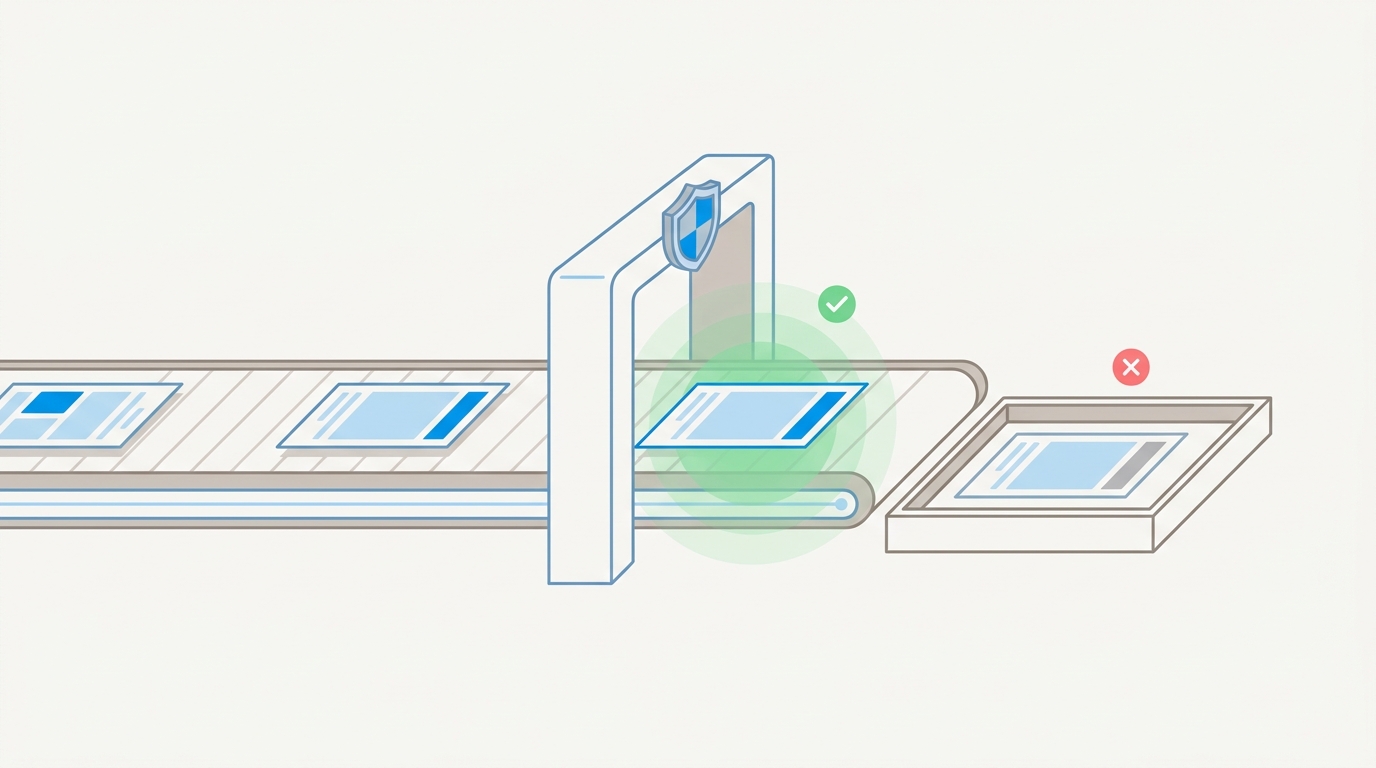
Meta’s review is automated first — AI systems scan every ad, with human reviewers stepping in for edge cases. Most ads clear within 24 hours. What gets checked is broader than most advertisers assume:
- The creative — image or video, including any text on it.
- The copy — primary text, headline, description.
- The targeting and how it combines with the content.
- The destination — Meta crawls where the click leads. For click-to-WhatsApp ads that’s your chat experience; for landing pages, a page that overpromises (“guaranteed results!”) can sink an ad whose copy was clean.
- Account history — the same ad gets more scrutiny on an account with recent violations.
And approval isn’t permanent: live ads can be re-reviewed and pulled later. Build compliant from the start, not “compliant enough to sneak through.”
The five rejections that hit lead-gen ads
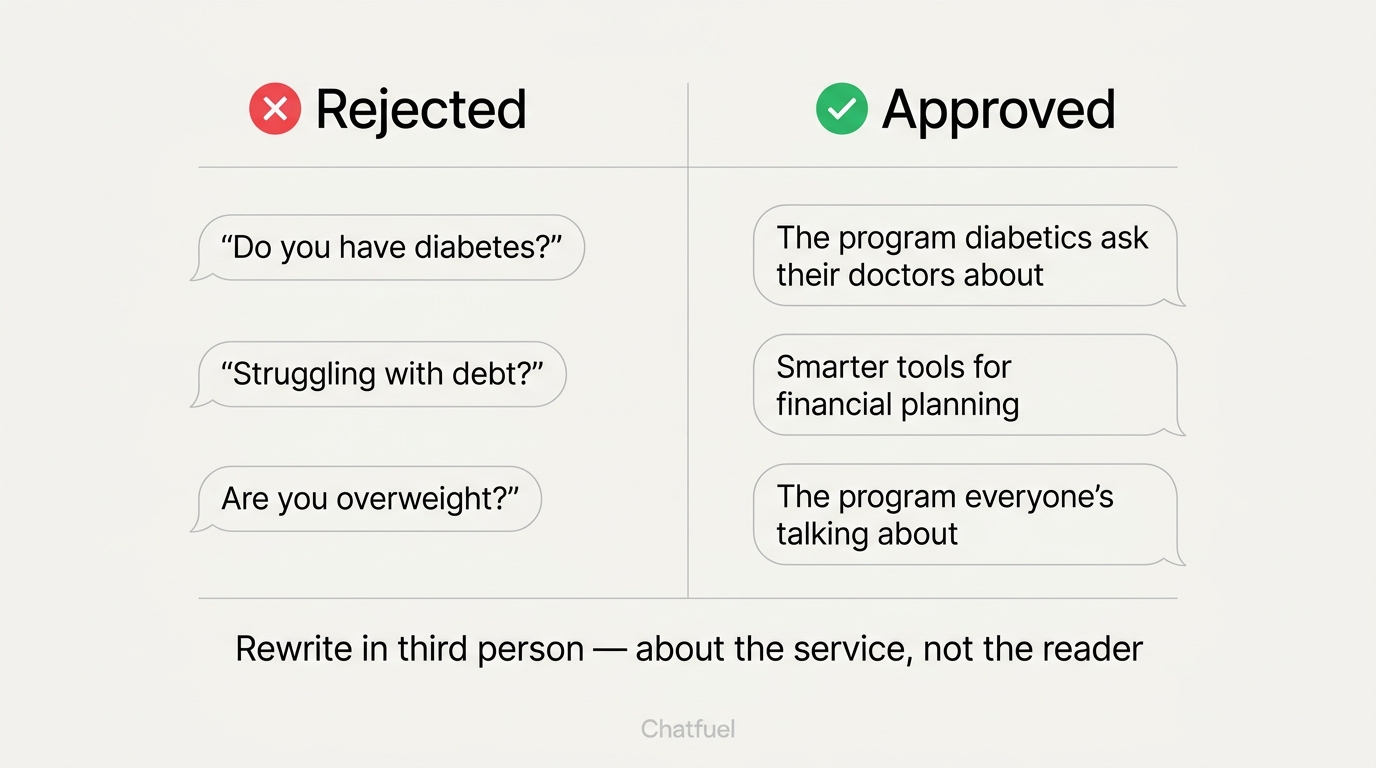
- Personal attributes. The big one for service niches. Ads may not assert or imply they know something personal about the viewer — health conditions, financial status, age, ethnicity, and more. Meta’s own disallowed examples: “Do you have diabetes?”, “Are you bankrupt?”, “Meet other seniors.” The fix is mechanical: rewrite in third person, about the service instead of the reader. “Are you overweight?” → “The program everyone’s talking about.” “Struggling with debt?” → “Smarter tools for financial planning.”
- Before/after and negative self-perception. Beauty and health classics. Transformation creatives for weight loss and anti-aging procedures (Botox, fillers) are prohibited when they imply something is wrong with the viewer. Sell the experience and the outcome-as-story, not the “before.”
- Unrealistic claims. Guaranteed results, specific numbers with no basis, fake urgency. Most policed in health, fitness, beauty, and finance — exactly the niches lead-gen agencies live in. Describe the mechanism, not a promised number.
- Special ad category violations. Housing, credit, employment, and financial products must be declared as such — see the note below.
- Circumventing systems. The one that ends accounts. Cloaked landing pages, misleading redirects, resubmitting a rejected ad over and over, spinning up new accounts to dodge a restriction — Meta treats these as intent to evade review, and recovery from that verdict is rare.
Special Ad Categories — read this if you run real estate
Housing ads (plus credit, employment, and financial products) must be declared as a Special Ad Category at campaign creation — failing to declare is itself a violation. Once declared, targeting is deliberately blunted: age locks to 18–65+, all genders included, no ZIP-code targeting, no Lookalike audiences. This is why the winning real-estate playbook is angle over audience: separate ads per intent — buyers, sellers, investors — with copy that self-selects, and let broad delivery find the people.
Click-to-WhatsApp specifics
Chat ads add one more reviewed surface: the WhatsApp side. Keep three things healthy:
- A verified Meta business — business verification is the foundation for running click-to-WhatsApp at scale; sort it during client onboarding.
- Number quality. Meta rates every WhatsApp business number on how recipients react. If more than about 5% of people block the number shortly after being messaged, the rating drops — and repeated drops throttle your messaging. A qualification bot that answers helpfully instead of blasting promos is your best quality insurance.
- A clean link between the ad’s Facebook Page and the WhatsApp number — mismatched or borrowed assets are a recurring source of “why was this rejected?” mysteries.
Rejected — now what
- Read the actual reason. Open Account Quality and check which policy and which asset was flagged — ad copy, creative, or destination. Fixing the wrong thing wastes an appeal.
- Decide: edit or appeal. If you can see the violation, edit and resubmit clean. If the rejection is genuinely wrong, request a review — but appeals are limited and decisions are usually final, so spend them on ads you’re confident in, with the violation actually removed.
- Never resubmit the same ad unchanged, repeatedly. To the review system that looks like circumventing enforcement — the fastest route from “one rejected ad” to “restricted account.”
- Protect the account like infrastructure. Two-factor authentication for everyone with access, consistent billing, no shared assets from unknown partners, landing pages that deliver what the ad promises. An agency’s ad account deserves the same care as a client’s production server.
AI-generated creatives and disclosure
Meta labels AI-generated and AI-modified media: photorealistic AI people get a visible tag, and provenance metadata from generation tools is read automatically. This is the 2026 normal — a label is not a penalty, and standard edits (cropping, color) don’t trigger it. What matters for review is the same as always: what the ad claims, not what tool made it.
Here Chatfuel quietly does you a favor: creatives from the AI Co-Worker are grounded in the client’s real Knowledge Base — no invented prices, no invented promos — and prohibited claim patterns like guaranteed income or guaranteed health results are caught and rewritten before the creative is even rendered. That doesn’t guarantee approval (nothing does), but it means your ads walk into review without the classic self-inflicted wounds.
Where to next
Creatives that arrive moderation-friendly by default.
Hooks that convert without tripping the personal-attributes policy.
Ad approved but underdelivering? Diagnose the rest of the funnel.
The messaging-window rule that shapes what happens after the click.